
The Executive Guide to Carbon Credits: Maximizing ESG Investing and Net Zero Strategy

In the high-stakes arena of global finance and corporate sustainability, the term “carbon credits” has evolved from a niche environmental concept into a cornerstone of Climate Finance. As multinational corporations and institutional investors pivot toward Net Zero targets by 2050, understanding the mechanics of the carbon market is no longer optional it is a critical component of Climate Risk Management and ESG Investing.
This comprehensive guide explores the intricate world of carbon offsets, detailing how they function, the high-value markets driving global trade, and how businesses can leverage them to achieve authentic decarbonization while avoiding the pitfalls of “greenwashing.”
What is a Carbon Credit? Defining the Digital Green Asset
At its core, a carbon credit is a tradable financial instrument representing the right to emit a specific amount of greenhouse gases. In the world of carbon accounting, one credit is equal to one metric ton of carbon dioxide ($CO_2$) or an equivalent amount of other potent gases like methane ($CH_4$).
The primary objective is to internalize the “external” cost of pollution. By putting a price on $CO_2$ emissions, the market incentivizes Renewable Energy adoption and technological innovation. For a business, purchasing these credits is a way to address its Scope 3 emissions—those indirect emissions that occur in its value chain which are often the hardest to eliminate.
The Two Pillars: Compliance vs. Voluntary Carbon Markets
To navigate this space effectively, stakeholders must distinguish between the two primary regulatory environments.
1. Compliance Markets: The “Cap-and-Trade” Powerhouses
Compliance markets are regulated by mandatory national or regional regimes. The European Union Emissions Trading System (EU ETS) is the world’s most liquid and expensive market.
- Mechanism: Governments set a strict “cap” on total allowable emissions.
- Trading: Companies are allocated or must auction for allowances. Those who reduce emissions can sell their excess permits to those who exceed their limits.
- Financial Impact: High-carbon industries face significant financial liabilities if they fail to modernize, making Energy Efficiency a top-tier investment.
2. The Voluntary Carbon Market (VCM)
The Voluntary Carbon Market is where private entities driven by CSR (Corporate Social Responsibility) and ESG Reporting requirements purchase credits to offset their carbon footprint.
- Demand Drivers: Investors now demand transparency regarding a company’s environmental impact. A robust Net Zero Strategy often relies on high-quality offsets to bridge the gap between current emissions and long-term goals.
- Pricing: Prices in the VCM vary wildly based on the “vintage” and project type, from low-cost renewable projects to high-value Nature-Based Solutions.
High-Value Carbon Offset Projects: Where to Invest?
Not all credits are created equal. In the current market, “quality” is the most expensive and sought-after attribute.
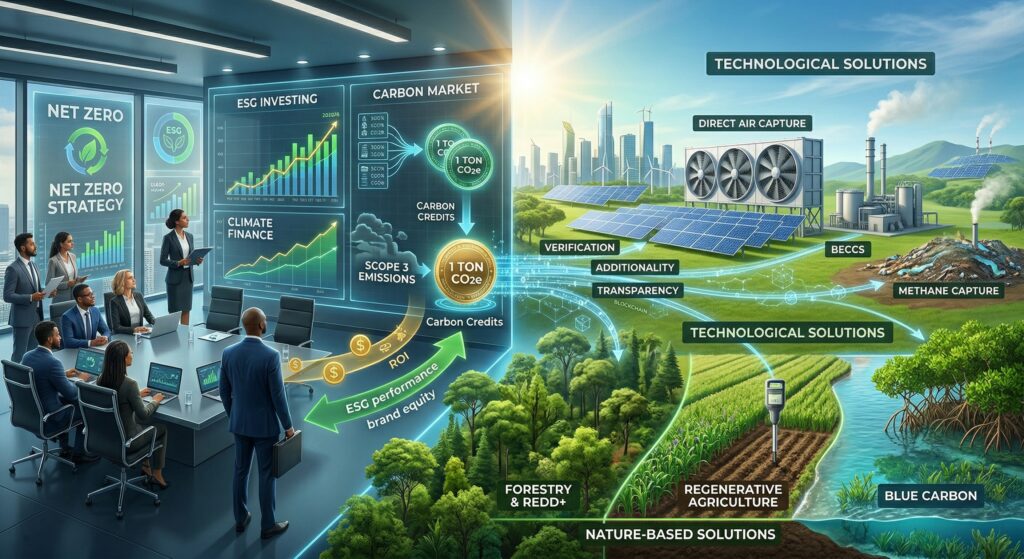
Nature-Based Solutions (NbS)
These projects leverage the Earth’s natural ecosystems to sequester carbon. They are popular because they often provide “co-benefits,” such as biodiversity protection and support for indigenous communities.
- REED+ Projects: Forest conservation efforts that prevent deforestation.
- Regenerative Agriculture: Soil carbon sequestration techniques that improve land health while trapping $CO_2$.
- Blue Carbon: Protecting coastal ecosystems like mangroves and seagrasses, which can store significantly more carbon than land-based forests.
Technology-Based Removal
For many ESG-focused funds, technological removals are the “gold standard” due to their permanence.
- Direct Air Capture (DAC): Sucking $CO_2$ directly out of the sky and storing it underground.
- Bioenergy with Carbon Capture and Storage (BECCS): Converting biomass into energy while capturing the resulting emissions.
- Methane Capture: Turning waste gas from landfills or agriculture into usable energy, a high-impact Climate Solution.
Ensuring Integrity: Additionality and Verification
The greatest risk to a Corporate Sustainability reputation is the accusation of greenwashing. To prevent this, credits must adhere to strict verification standards.
The Concept of Additionality
A project is only valid if the carbon reduction is “additional.” This means the reduction would not have occurred without the financial support of the carbon credit sale. If a wind farm was already profitable without the credits, it may fail the additionality test.
Third-Party Registries
To ensure transparency, credits are issued by globally recognized standards:
- Verra (VCS): The world’s most widely used voluntary program.
- Gold Standard: Known for its rigorous focus on sustainable development co-benefits.
- American Carbon Registry (ACR): A leader in high-integrity environmental markets.
The ROI of Carbon Credits in ESG Investing
Why are carbon credits considered a high-value asset class? Beyond the environmental impact, they offer significant strategic advantages:
- Risk Mitigation: As carbon taxes become more prevalent globally, early adoption of decarbonization software and credit portfolios protects companies from future regulatory shocks.
- Brand Equity: Consumers are increasingly willing to pay a premium for “Carbon Neutral” or “Climate Positive” products.
- Access to Capital: Many of the world’s largest banks now link interest rates to a company’s ESG performance. A credible Net Zero roadmap can literally lower the cost of debt.
The Future: Blockchain, Article 6, and Market Maturity
The landscape is shifting toward increased digitization. Blockchain technology is being used to create immutable ledgers for carbon credits, eliminating the risk of “double-counting” and increasing liquidity.
Furthermore, Article 6 of the Paris Agreement is paving the way for a unified international carbon market. This will allow countries to trade credits across borders, potentially stabilizing prices and driving massive investment into developing nations’ green infrastructures.
Strategic Summary: Navigating the Market
| Keyword / Concept | Business Application | Market Value |
| ESG Investing | Attracting institutional capital through green metrics. | Extremely High |
| Net Zero Strategy | Long-term operational planning for zero emissions. | Critical |
| Climate Finance | Funding the transition to a low-carbon economy. | Growth Sector |
| Scope 3 Emissions | Addressing the supply chain’s carbon footprint. | High Difficulty |
| Decarbonization | The core process of removing carbon from operations. | Competitive Advantage |
Conclusion
Carbon credits are the bridge between our current fossil-fuel-dependent economy and a sustainable future. For the modern executive, they represent more than just an environmental tool; they are a sophisticated financial instrument used to manage Climate Risk and drive Corporate Sustainability.
By investing in high-quality, verified credits and prioritizing internal decarbonization, businesses can secure their place in the emerging green economy, satisfying both the planet and their shareholders.
Professional Insight
The most successful companies don’t just “buy” their way to neutrality; they integrate carbon accounting into their DNA, treating $CO_2$ like any other line item on a balance sheet.